

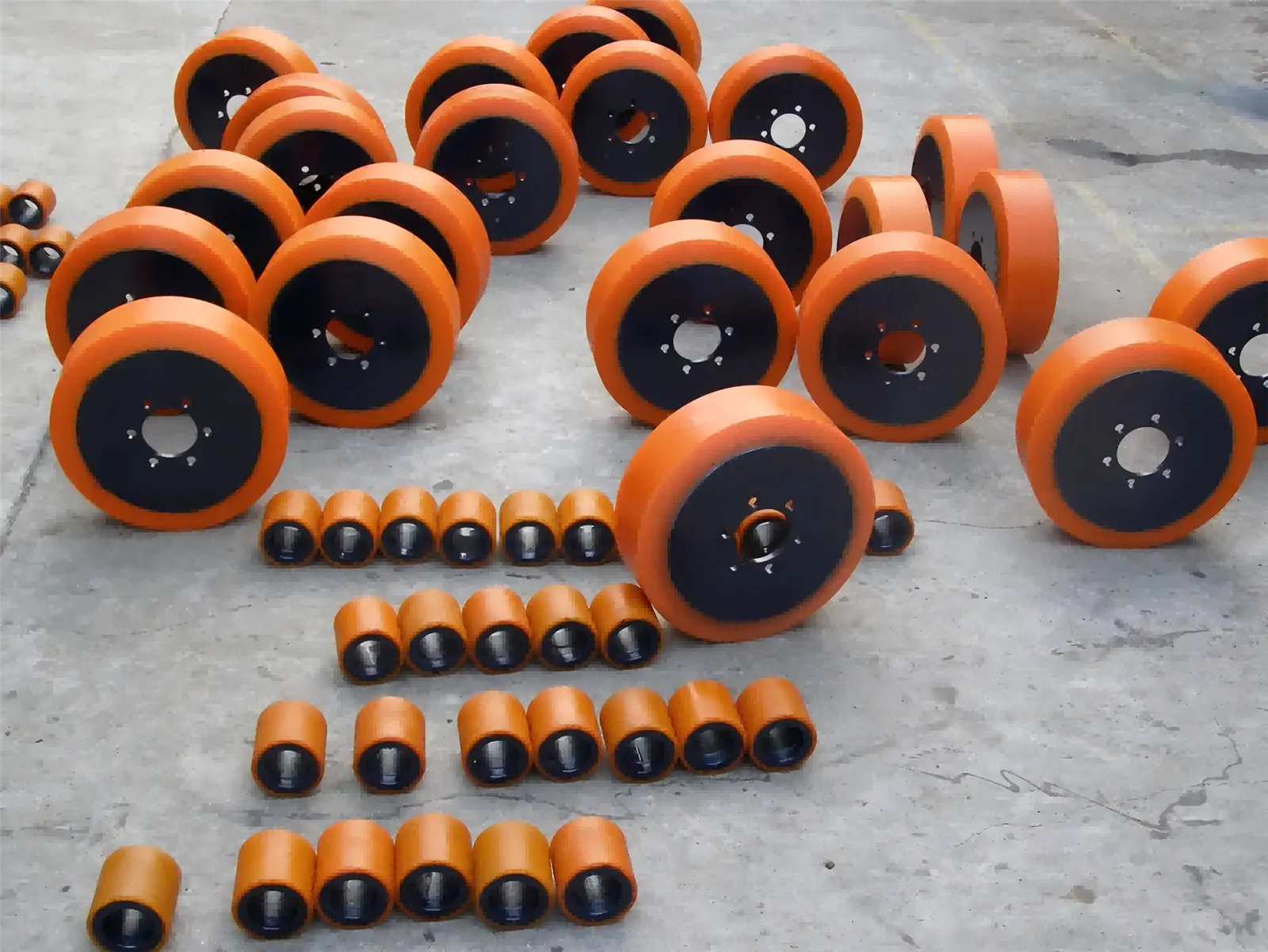
In manufacturing and logistics applications, wheels serve as the core execution components of material handling equipment, and their anti-slip performance has a direct impact on operational safety, handling efficiency, and overall service life. As the mainstream material for AGV drive wheels and industrial driven wheels, polyurethane (PU) is widely adopted due to its excellent elasticity, wear resistance, and tear strength. The realization of reliable anti-slip performance, however, fundamentally depends on tread pattern design.
From an engineering perspective, this article provides an in-depth technical analysis of six mainstream anti-slip tread patterns for polyurethane drive wheels, focusing on their design logic, key performance parameters, and application boundaries. The objective is to offer professional guidance for drive wheel selection and customized wheel design in logistics and manufacturing systems.
I. Core Engineering Logic of Anti-Slip Tread Design
The anti-slip performance of a polyurethane drive wheel is essentially the result of optimized mechanical interaction between the tread pattern and the contact surface. The primary evaluation metrics include:
Coefficient of friction (μ)
The static friction coefficient between the tread and the floor determines the maximum anti-slip capability and must satisfy:
μ ≥ F / N
where F is the required friction force and N is the total wheel load.
Contact stress distribution
A well-designed tread pattern ensures uniform contact stress, preventing localized stress concentration that may lead to premature tread wear or floor damage.
Media adaptability
For environments involving water, oil contamination, or standing liquid, tread geometry must enable effective drainage, oil discharge, or prevention of vacuum adhesion.
Load–anti-slip balance
Tread design must balance load capacity (positively correlated with wheel hardness and effective cross-sectional area) and anti-slip performance (highly dependent on contact area and tread geometry).
Key conclusion:
The core of polyurethane AGV drive wheel tread design lies in matching operating load, floor characteristics, and environmental media by optimizing tread parameters-width, spacing, depth, and regularity-together with material hardness, to achieve a dynamic balance among friction coefficient, load capacity, and wear resistance.
II. Technical Analysis of Six Mainstream Anti-Slip Tread Patterns
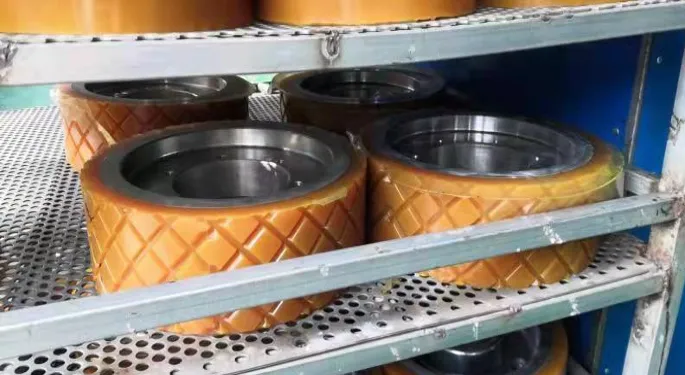
(1) Wide Diamond Tread: Load–Grip Balance for Heavy-Duty Drive Wheels
Structural parameters
Tread width: typically 4–6 mm (2–3 times wider than fine patterns)
Tread spacing: 3–5 mm to limit deformation under load
Hardness range: 85A–95A (Shore A)
Technical characteristics
Anti-slip mechanism
Relies on rigid friction generated by high-hardness PU. The wide spacing minimizes tread compression under heavy loads, maintaining a stable friction coefficient.
Load optimization
The effective tread cross-sectional area accounts for 40–50% of the contact area, enabling contact stress levels of approximately 2–3 MPa.
Wear resistance
The wide tread structure exhibits strong tear resistance. Under heavy-duty conditions, wear is typically ≤0.5 mm per 1000 km, with service life extended by more than 30% compared to fine tread designs.
Application boundaries
Suitable for:
Medium- to heavy-duty AGVs and industrial drive wheels with single-wheel loads ≥200 kg; concrete or asphalt floors with surface roughness Ra ≥6.3 μm.
Not recommended for:
Smooth epoxy floors (Ra ≤1.6 μm) or continuous oil-contaminated environments, where oil accumulation in wide grooves may significantly reduce friction.
(2) Fine Diamond Tread: Optimal Anti-Slip Solution for Smooth Floors and Mixed Media
Structural parameters
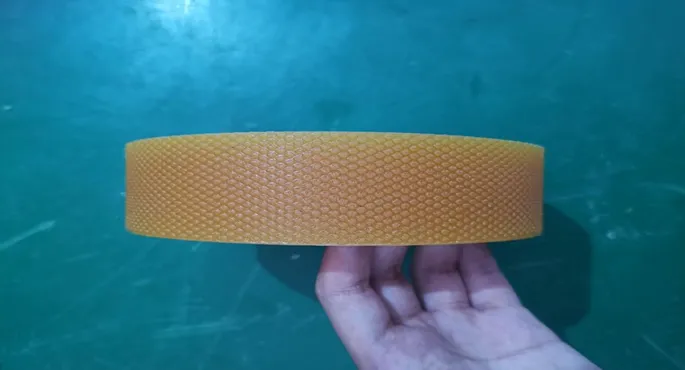
Tread width: 1–2 mm
Tread spacing: 1–3 mm
Hardness range: 75A–85A
Technical characteristics
Anti-locking effect
Dense micro-gaps (approximately 0.5–1 mm) effectively discharge water and oil, preventing vacuum adhesion that may hinder AGV start-up or braking.
Superior friction performance
Multi-point contact design achieves static friction coefficients of μ ≥0.65 on wet epoxy floors, representing an improvement of over 40% compared to wide tread designs.
Stress control
Each micro-contact unit experiences contact stress of about 1–1.5 MPa, remaining below the fatigue limit of PU and delaying crack initiation.
Application boundaries
Suitable for:
Light to medium-duty AGV drive wheels with single-wheel loads ≤200 kg; smooth floors such as epoxy coatings or ceramic tiles.
Special scenarios:
Moist or oil-prone environments, including food processing plants and wash-down logistics corridors.
(3) Shallow Random Pit Tread: Cost-Optimized Solution for Temporary Applications

Structural parameters
Pit depth: 0.5–1 mm
Pit diameter: 3–6 mm, randomly distributed
Coverage ratio: approximately 30–40%
Hardness range: 70A–80A
Technical characteristics
Cost advantage
Simple mold geometry reduces manufacturing cost by 30–50% compared with regular tread patterns.
Performance limitations
Limited drainage capability and unstable friction performance, with μ fluctuation up to ±0.15.
Moderate wear resistance
Lower shear strength; anti-slip performance may degrade by over 50% after approximately 5000 km of operation.
Application boundaries
Suitable for:
Light to medium loads, with recommended working loads limited to 70% of rated capacity; rough concrete or terrazzo floors.
Usage limitation:
Primarily for short-term or transitional use, such as temporary equipment replacement or time-critical projects.
(4) Deep Staggered Groove Tread: Drainage–Load Balance for Wet Surfaces

Structural parameters
Groove depth: 3–5 mm
Groove width: 2–4 mm, staggered layout
Supporting ribs: spacing 8–12 mm, cross-sectional area 4–6 mm²
Hardness range: 80A–90A
Technical characteristics
Efficient drainage
Staggered deep grooves form three-dimensional drainage channels with flow rates of 2–4 L/(m²·min), significantly reducing water film lubrication.
Load-bearing design
Supporting ribs carry more than 70% of the load, enabling single-wheel capacities of 150–300 kg.
Limitations
Independent ribs may crack under prolonged operation on rough floors and require periodic inspection.
Application boundaries
Suitable for:
Persistent wet surfaces, outdoor pathways, and wash-down areas; medium-load AGV drive wheels and cleaning equipment.
Not recommended for:
Floors with sharp debris that may embed in grooves and cause tearing.
(5) Deep Straight Groove Tread: High-Drainage Solution for Lightweight Drive Wheels

Structural parameters
Groove depth: 4–6 mm
Groove width: 2–3 mm, continuous parallel layout
Coverage ratio: approximately 20–30%
Hardness range: 70A–80A
Technical characteristics
Outstanding drainage performance
Continuous grooves achieve drainage rates of 4–6 L/(m²·min), approximately 50% higher than staggered designs.
Surface conformity
Lower hardness enhances surface contact, maintaining μ ≥0.6 even under water-film conditions.
Load limitation
Lower tread coverage restricts single-wheel load to ≤100 kg; typical wear rate is about 0.8 mm per 1000 km.
Application boundaries
Suitable for:
Deep-water environments and high-humidity conditions.
Typical applications:
Marine cleaning robots, lightweight climbing robots.
Design rationale:
Sacrifices load capacity and wear resistance to maximize drainage for specialized lightweight equipment.
(6) Deep Chevron (Herringbone) Tread: High-Durability Solution for Traction Drive Wheels

Structural parameters
Tread spacing: 6–10 mm
Groove depth: 4–5 mm
Chevron angle: 60–90°
Tread rib thickness: 3–4 mm
Hardness range: 80A–90A
Technical characteristics
Traction optimization
Directional chevron geometry creates coordinated "grip–drive" interaction, improving traction force by approximately 30% compared with straight grooves. Stable traction is maintained on slopes up to 5°.
Excellent wear control
Thickened ribs and optimized angles limit wear to ≤0.3 mm per 1000 km, extending service life by roughly 25% compared with staggered grooves.
Stress distribution
Chevron geometry distributes contact stress along the tread direction, reducing crack initiation.
Application boundaries
Suitable for:
Low-speed traction drive wheels (≤5 km/h), climbing equipment, and medium- to heavy-duty AGVs.
Floor compatibility:
Concrete, asphalt, and other common industrial surfaces.
Core advantage:
Supports single-wheel loads of 200–400 kg while delivering long service life and reliable traction, making it a preferred solution for high-demand logistics drive wheels.
III. Selection Matrix and Key Engineering Considerations
1. Comparative Selection Matrix
| Tread Type | Hardness Range | Friction Coefficient (Dry) | Max Single-Wheel Load | Service Life (Heavy Duty) | Typical Applications |
|---|---|---|---|---|---|
| Wide Diamond | 85A–95A | 0.55–0.65 | ≥300 kg | >8000 km | Heavy-duty AGVs, rough floors |
| Fine Diamond | 75A–85A | 0.65–0.75 | ≤200 kg | >7000 km | Smooth floors, wet/oily areas |
| Random Pit | 70A–80A | 0.45–0.60 | ≤150 kg (70%) | <3000 km | Temporary, light-duty |
| Deep Staggered Groove | 80A–90A | 0.60–0.70 | 150–300 kg | >6000 km | Wet surfaces, medium load |
| Deep Straight Groove | 70A–80A | 0.55–0.65 | ≤100 kg | >5000 km | Deep water, lightweight robots |
| Deep Chevron | 80A–90A | 0.65–0.75 | 200–400 kg | >8000 km | Traction, climbing AGVs |
2. Key Technical Notes
Hardness–tread matching
High hardness (≥90A) should be paired with wide or large-section treads to compensate for reduced contact area. Lower hardness (≤75A) benefits from deep or fine tread structures to enhance friction.
Media correction factor
For oily environments, fine treads with spacing ≤2 mm are preferred. For wet conditions, drainage capacity should satisfy:
Q ≥ v × A
where v is vehicle speed and A is contact area.
Service life estimation
Wheel service life L can be approximated by:
L = h / (k × t)
where h is initial tread depth, k is wear rate, and t is average daily operating time. A 20–30% wear margin is recommended during selection.
Conclusion
The design and selection of polyurethane AGV drive wheel anti-slip tread patterns is a systematic engineering task that must integrate load conditions, operating speed, floor characteristics, and environmental media. The six tread types analyzed in this article address distinct technical priorities, each representing a different balance among friction, load capacity, drainage, and wear resistance.
For professionals in manufacturing and logistics, understanding the engineering logic behind tread patterns enables safer operation, higher efficiency, and reduced long-term maintenance costs. As logistics equipment continues to evolve toward higher speed, heavier loads, and smarter operation, future drive wheel tread design will increasingly integrate material science, mechanical simulation, and intelligent sensing technologies to achieve more precise and durable performance optimization.


