

In modern manufacturing and industrial logistics, Automated Guided Vehicles (AGVs) have become an essential part of intelligent material handling systems.
For an AGV system expected to operate reliably over many years, the navigation technology does much more than determine the vehicle's travel path. It directly influences positioning accuracy, operational stability, maintenance costs, and future system scalability.
When evaluating an AGV solution, many manufacturers focus on payload capacity, travel speed, battery life, or fleet management software. In practice, however, the navigation system is one of the most critical factors affecting long-term system reliability.
Each navigation technology offers unique advantages:
Magnetic tape navigation is recognized for its outstanding stability and is widely used in fixed-route industrial production lines.
QR code navigation provides greater deployment flexibility, making it suitable for warehousing and dynamic logistics applications.
SLAM navigation eliminates the need for floor markers, enabling highly flexible operation in smart factories and complex environments.
Rather than asking which navigation technology is the best, manufacturers should determine which solution best matches their production environment and operational requirements.
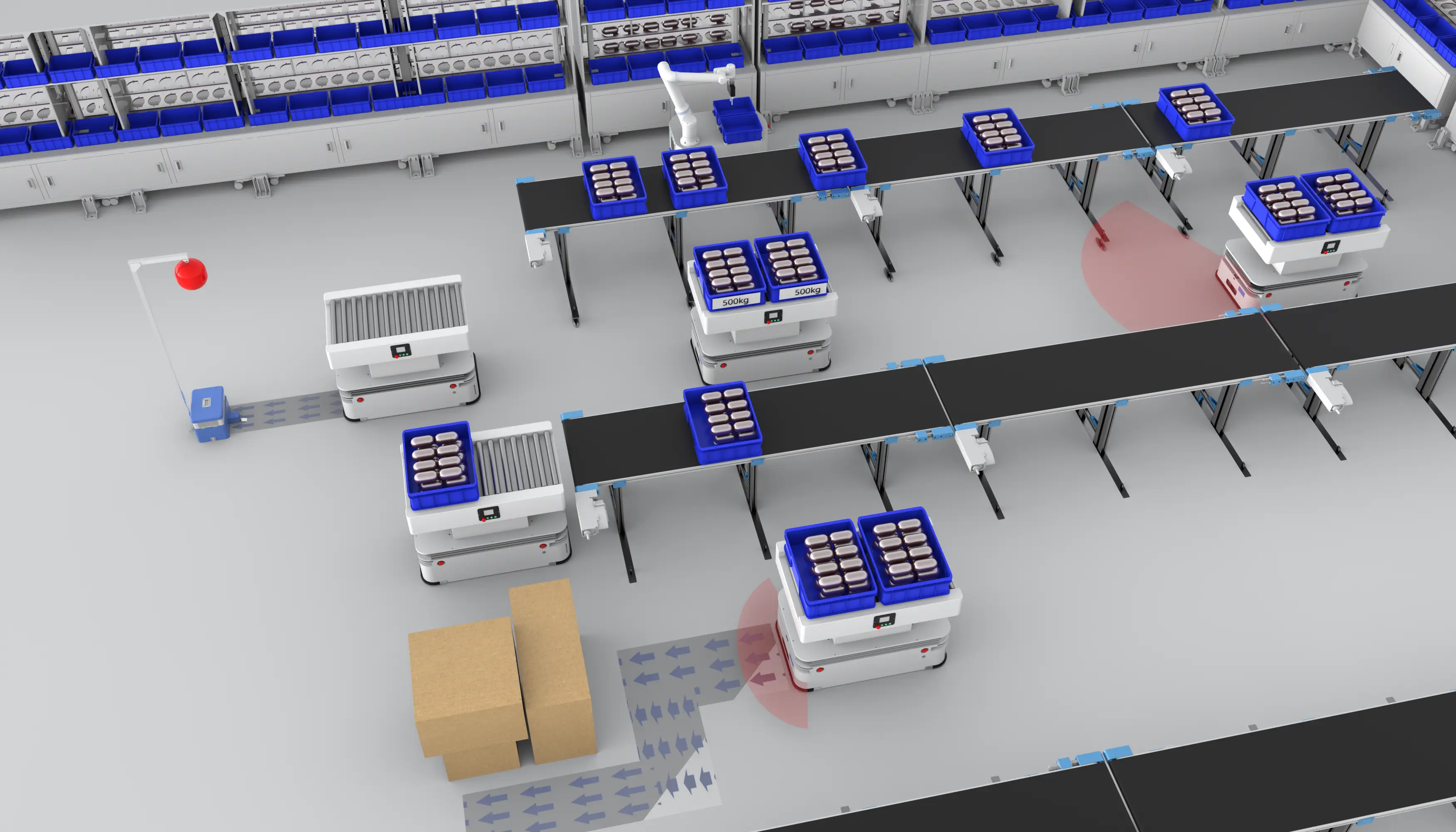
1. Why Is AGV Navigation So Important?
A complete AGV system typically consists of:
Mechanical structure
Drive system
Motion controller
Navigation and positioning system
Fleet management software
Among these components, the navigation system performs two essential tasks:
Determining the AGV's real-time position.
Guiding the vehicle safely and accurately along its assigned route.
An effective AGV navigation solution should deliver:
Accurate positioning
Stable long-term operation
Easy maintenance
Adaptability to changing production environments
In industries such as automotive manufacturing, lithium battery production, and heavy equipment manufacturing, AGVs often operate around the clock. Navigation reliability therefore has a direct impact on production efficiency and system uptime.
2. Magnetic Tape Navigation: A Proven Solution for Stable Industrial Applications
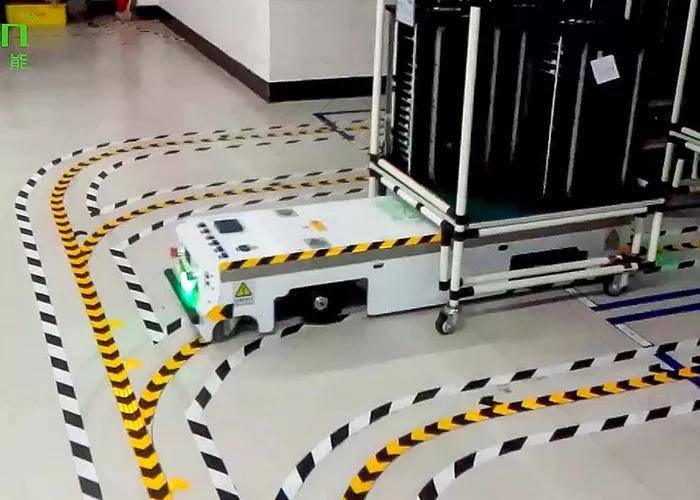
How It Works
Magnetic tape navigation uses magnetic sensors mounted underneath the AGV to detect magnetic tape installed on the floor. The vehicle continuously follows the magnetic field while making real-time steering corrections to stay on its designated path.
Thanks to its mature technology and excellent reliability, magnetic tape navigation remains one of the most widely adopted solutions in industrial AGV systems.
Technical Specifications
| Item | Specification |
|---|---|
| Navigation Accuracy | Approximately ±10 mm |
| Positioning Method | Magnetic field detection |
| Controller | PLC or industrial controller |
| Route Modification | Requires new magnetic tape installation |
| Typical Service Life | More than 3 years |
Key Advantages
Excellent Operational Stability
Because magnetic signals are continuously detected during travel, the AGV can constantly correct its trajectory, minimizing the risk of path deviation.
This makes magnetic tape navigation particularly suitable for:
Lithium battery PACK production
Automotive assembly lines
Heavy-duty material transportation
Fixed-route manufacturing logistics
Low Maintenance Cost
If a section of magnetic tape becomes damaged due to heavy traffic or floor wear, only the affected portion needs to be replaced without recalibrating the entire system.
Mature and Reliable Control Architecture
Magnetic tape systems commonly utilize industrial PLC controllers, providing proven reliability and simplifying maintenance throughout the equipment lifecycle.
Limitations
Route changes require floor modifications.
Initial installation requires floor preparation.
Less suitable for highly dynamic production layouts.
Typical Applications
Automotive manufacturing
Lithium battery production
Heavy-duty AGV transportation
Fixed-route material handling
3. QR Code Navigation: A Flexible Positioning Solution
How It Works
QR code navigation uses onboard cameras to recognize floor-mounted QR codes for position correction.
Between two QR codes, the AGV typically relies on an Inertial Measurement Unit (IMU) to maintain its trajectory.
Technical Specifications
| Item | Specification |
|---|---|
| Navigation Accuracy | Approximately ±10 mm |
| Positioning Accuracy | Up to ±5 mm |
| Navigation Method | QR code recognition + IMU |
| Route Modification | Reposition QR codes |
Key Advantages
Flexible Layout Adjustment
Unlike magnetic tape systems, QR code navigation allows production routes to be modified simply by relocating floor labels.
This significantly reduces deployment time when warehouse layouts change.
High Positioning Accuracy
QR codes provide highly accurate positioning within the recognition area, making them suitable for applications requiring precise docking.
Limitations
Environmental Sensitivity
QR codes must remain clean and clearly visible.
Dust, oil contamination, and physical wear may reduce recognition accuracy.
Higher Maintenance Requirements
Replacing QR codes generally involves:
Locating the correct code
Printing replacement labels
Accurate positioning
System recalibration
Maintenance complexity increases as facility size grows.
Typical Applications
Automated warehouses
E-commerce fulfillment centers
Small AGVs
Flexible manufacturing
4. SLAM Navigation: The Future of Flexible AGV Navigation
How It Works
SLAM (Simultaneous Localization and Mapping) combines LiDAR or vision sensors with advanced localization algorithms to build maps, determine vehicle position, and plan navigation paths in real time.
Unlike traditional navigation technologies, SLAM does not require magnetic tape or QR codes.
Key Advantages
No Floor Infrastructure
No floor markers or guide paths are required, making deployment faster while reducing installation costs.
Maximum Route Flexibility
Navigation routes can be updated entirely through software without modifying factory infrastructure.
SLAM is particularly suitable for:
Mixed AGV fleets
Dynamic manufacturing environments
Smart factories
Frequently changing production layouts
Intelligent Path Planning
When integrated with fleet management software, SLAM navigation supports:
Dynamic obstacle avoidance
Multi-vehicle coordination
Intelligent route optimization
Limitations
Higher algorithm complexity
Greater initial investment
Environmental changes may require map updates
Higher performance requirements for sensors and controllers
Typical Applications
Smart warehousing
Flexible manufacturing
Semiconductor production
Complex industrial facilities
5. Comparison of AGV Navigation Technologies
| Feature | Magnetic Tape | QR Code | SLAM |
|---|---|---|---|
| Operational Stability | High | Medium | High |
| Route Flexibility | Low | High | Excellent |
| Infrastructure Requirement | Floor installation | Floor labels | None |
| Maintenance | Simple | Moderate | Software-oriented |
| Positioning Accuracy | ±10 mm | ±5–10 mm | ±10–20 mm |
| Typical Applications | Fixed production lines | Flexible logistics | Smart manufacturing |
6. How to Select the Right Navigation Technology
Choosing the right navigation method depends primarily on three factors.
Production Layout
For fixed production lines operating continuously, magnetic tape navigation remains one of the most reliable solutions.
For frequently changing production layouts, QR code or SLAM navigation offers greater flexibility.
Operating Environment
Clean indoor environments are suitable for all three navigation technologies.
Facilities exposed to dust, oil, moisture, or frequent layout changes should carefully evaluate QR code performance, with SLAM often becoming the preferred solution.
Overall Motion System
Navigation alone does not determine AGV performance.
A reliable AGV also depends on high-quality motion components, including:
AGV drive wheels
Low-voltage servo motors
Servo drives
Motion control systems
Plutools specializes in core motion technologies for AGV and AMR applications, offering AGV drive wheels, low-voltage servo motors, servo drives, and integrated motion control solutions for manufacturers worldwide.
By combining reliable motion components with the appropriate navigation technology, manufacturers can improve system stability, positioning accuracy, and long-term operational efficiency.
7. Future Trends: Multi-Sensor Fusion Navigation
The future of AGV navigation is moving beyond single-technology solutions toward multi-sensor fusion.
Typical examples include:
Magnetic Tape + SLAM
LiDAR + Vision
GPS + LiDAR + Magnetic Markers for outdoor heavy-duty AGVs
By integrating multiple navigation technologies, manufacturers can balance positioning accuracy, operational stability, flexibility, and deployment efficiency across a wide range of industrial applications.


