

Introduction
In high-end discrete manufacturing fields such as automotive production and component warehousing, laser-guided AGVs are becoming a core solution for flexible material handling. A high-performance AGV system relies not only on advanced navigation and scheduling algorithms but also on stable and precise motion execution units.
Plutools focuses on the R&D and manufacturing of drive wheels, servo motors, and low-voltage drives, providing highly integrated power solutions for the AGV industry. This article presents an in-depth analysis of a typical low-lift laser-guided AGV system from six aspects: hardware topology, positioning mathematical models, technical advantages, functional modules, vehicle specifications, and onboard safety components-while highlighting the critical role of Plutools in motion control.

1. Hardware Network Architecture of Laser-Guided AGV System
1.1 Overall System Topology

Laser-guided AGV systems typically adopt a four-layer distributed architecture:
Upper Layer (Management Level): MES, scheduling PC, PLC-responsible for task assignment and monitoring
Network Layer: Industrial Ethernet + wireless AP (802.11b/g), enabling multi-vehicle communication
Vehicle Control Layer: Main controller, wireless module, laser scanner, and motion components (Plutools drive wheels, motors, and drives)
Field Equipment Layer: Charging stations, conveyor lines, lifts, etc., enabling seamless logistics integration
1.2 Onboard Operation Logic
The onboard controller processes real-time laser scanning data and drives actuators accordingly. Only reflective markers are required on the ground-no wires or magnetic strips are needed.
The system stores path maps in both the host computer and controller. By combining laser triangulation with encoder odometry, the AGV achieves trackless autonomous navigation.
At the motion execution level, Plutools' integrated drive wheels and servo drives respond directly to control commands, ensuring smooth start/stop behavior and precise speed control-forming the foundation for centimeter-level closed-loop positioning.
2. Mathematical Principles of Laser Positioning

2.1 Basic Principle
The AGV detects at least three reflectors and calculates its global position and orientation based on their coordinates and relative angles.
2.2 Geometric Positioning Model
Assume reflector coordinates A, B, C are (x₁, 0), (x₂, y₂), and (0, 0), and the AGV position is T(x, y). Using the circle intersection method:

L₁: distance from AGV to A
L₂: distance from AGV to C
By solving the equations, the AGV's position and heading can be uniquely determined, achieving centimeter-level accuracy.
2.3 Dynamic Position Correction
The system recalculates position every 50 ms, eliminating inefficient "segmental blind movement + intermittent correction."
Laser data is fused with encoder odometry to compensate for slip and vibration.
Plutools drive wheels integrate high-resolution encoders and closed-loop control algorithms, ensuring high-fidelity odometry and long-term positioning stability.
3. Core Technical Advantages

3.1 Advanced Performance
±5 mm repeatability: Ideal for high-precision docking (e.g., automotive assembly)
Achieved largely through low-speed stability of Plutools servo drives with high-bandwidth current/velocity loops
Robust wireless communication: Based on 802.11b/g, supports multi-AGV operation
Modular hardware design: Quick fault localization and replacement
Software-defined routing: No physical modification required
Multi-AGV coordination: Intelligent traffic control to prevent congestion
3.2 Deployment Flexibility
Only reflectors are needed-no ground modification. Route changes are implemented via software, ideal for mixed-model production lines.
3.3 Cost Efficiency
Eliminates guide line installation costs
No production downtime during layout changes
Plutools' standardized drive modules reduce integration complexity and maintenance costs
Lower total lifecycle cost
4. Core Functional Modules
4.1 Intelligent Scheduling
Task prioritization and sequencing
Dynamic vehicle allocation based on location, battery, and status
Traffic control (collision avoidance, deadlock resolution)
Dual communication: wired Ethernet + wireless LAN
4.2 Monitoring & Management
Real-time tracking of AGV status and faults
Dynamic traffic updates
Communication health monitoring
Congestion resolution algorithms
4.3 Visualization Platform
Real-time AGV position, trajectory, and status display
User permission management
Logs and report generation
Manual task dispatch
Smart alarms (charging timeout, blockage, offline, etc.)
4.4 Flexible Path & Station Adjustment
Paths and stations can be edited online with immediate effect-no downtime required.
4.5 Automatic Charging Management
Side-contact automatic charging
Auto task request when battery is low
Smart charger allocation and routing
Automatic docking and charging
Charging ratio up to 1:8
5. Key Specifications of Low-Lift AGV
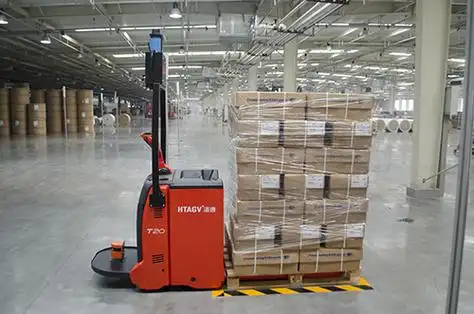
Taking Linde L14/L16 as a benchmark:
Dimensions: 1950 × 800 × 2100 mm
Load Capacity: 1400 / 1600 kg
Turning Radius: 1615 mm
Drive Mode: Front-wheel steering drive (SD)
Lifting Height: 90–225 mm
Speed: 0–1.2 m/s
Acceleration: 300–500 mm/s²
Climbing Ability: 16% (no load) / 9% (full load)
Accuracy: ±5 mm
Battery: 24V / 190 Ah
Plutools provides horizontal or vertical drive wheel units with integrated servo motors and encoders, supporting 24V/48V platforms and meeting heavy-load torque requirements.
6. Onboard Components & Safety Systems
6.1 Laser Navigation System
Equipped with SICK NAV350:
Max detection: 70 m
Works in low-reflectivity environments
Hybrid navigation (reflector + contour)
Built-in processing reduces controller load
Supports online configuration and self-learning
6.2 Dual-Level Safety Protection

Adjustable deceleration zone (up to 4 m)
Emergency stop zone (front 3 m / rear 1 m)
Redundant safety: contact bumper for physical collision protection
6.3 Motion Control Core (Plutools)
Integrated Drive Wheel: Motor + gearbox + encoder + wheel
Servo Drive: 24V/48V, >200A peak current, CANopen/EtherCAT
Motor: PMSM with low torque ripple, ≥17-bit encoder
Speed accuracy up to ±0.1%
6.4 Alarm & Operation Modes
Visual indicators (auto/manual modes)
Audible and visual alarms (turning, reversing, faults)
Three modes: manual, semi-auto, full-auto
Conclusion
Low-lift laser-guided AGVs integrate laser triangulation, wireless networking, intelligent scheduling, and dual-layer safety protection to achieve high-precision, flexible, and trackless material handling.
As a key supplier of motion control components, Plutools specializes in drive wheels, motors, and drives, delivering high-reliability and high-integration solutions. By continuously optimizing motor control algorithms and wheel design, Plutools enables smoother motion, higher positioning accuracy, and lower energy consumption-driving the evolution of intelligent, unmanned industrial logistics.


