

In various AGV solutions used for intralogistics, the chassis mobility system is often one of the first considerations in design, yet one of the last components to be fully optimized. Unlike navigation algorithms, which are highly visible, or dispatching systems, which are dynamically managed, the mobility system fundamentally determines how stable, agile, and precise an AGV can be.
Differential drive wheels, steering drive wheels, and casters form an engineering "triangle" of trade-offs among cost, precision, and flexibility. Different combinations and compromises ultimately define the mobility characteristics of an AGV.
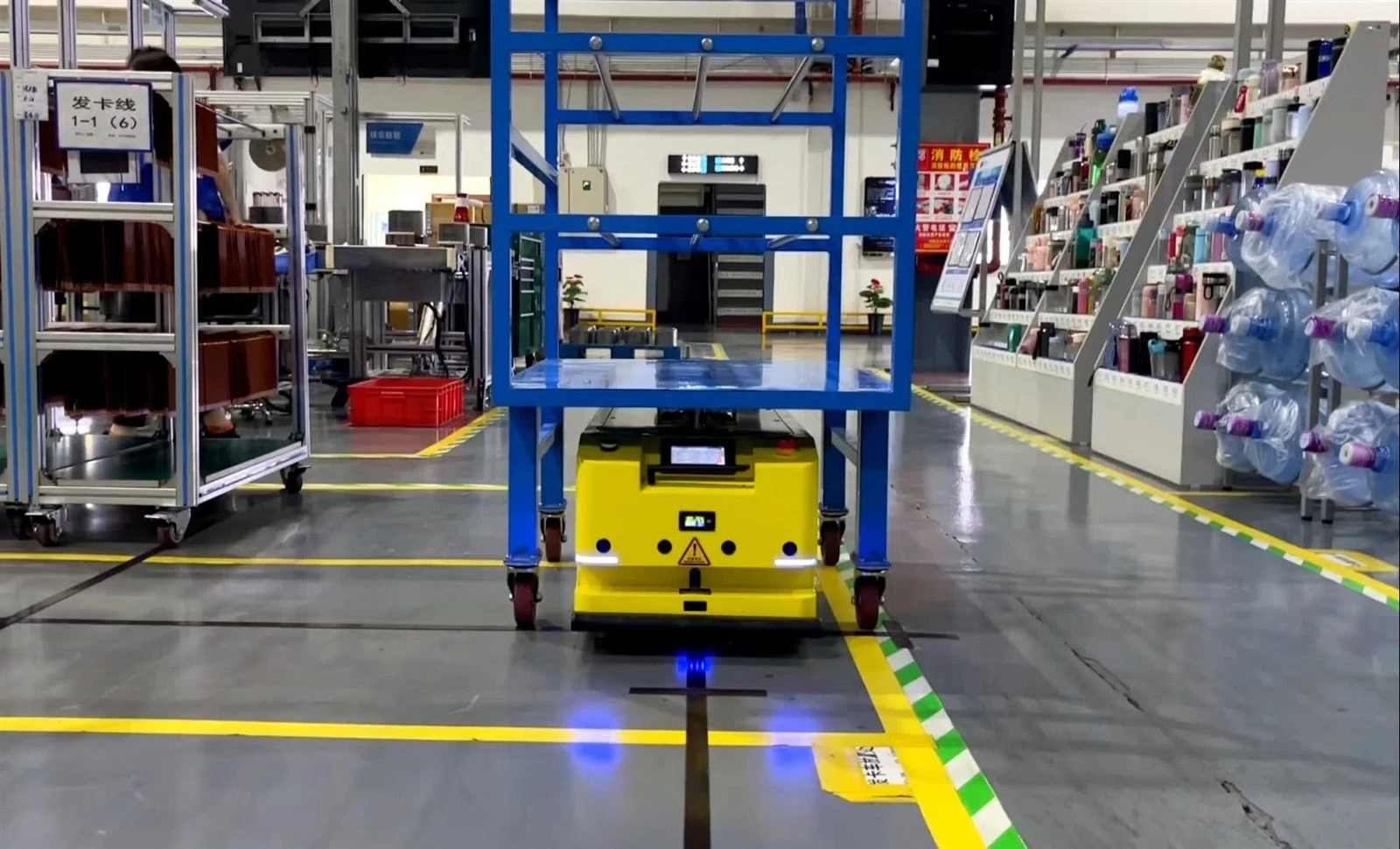
1. Differential Drive Wheels: Technical Characteristics and Application Boundaries
Differential drive wheels are the core power-output components of an AGV. Differential drive is the most widely adopted propulsion solution for light- and medium-duty AGVs, achieving steering and movement through speed differences between the left and right drive wheels.
1.1 Understanding Differential Motion
The principle of differential steering is intuitive. When the left wheel rotates faster than the right wheel, the vehicle naturally turns right. If both wheels rotate in opposite directions at the same speed, the AGV can rotate around its own center point.
This steering method relies entirely on wheel speed differences, making differential drive particularly suitable for applications where basic turning capability is sufficient. Examples include transporting racks or materials between fixed points where lateral movement and millimeter-level positioning accuracy are not required.
1.2 Advantages and Limitations
The advantages of differential drive wheels are straightforward:
- Low cost
- Robust and durable structure
- Easy maintenance
- Mature ecosystem of motors and controllers
- Simple control algorithms
However, differential drive systems also have clear limitations.
Since the two wheels operate independently, uneven tire wear and minor floor irregularities can gradually cause the AGV to deviate from its intended path during long-distance travel. While this may not be problematic in open spaces, it can significantly impact automatic docking with production equipment and workstations.
Additionally, differential-drive AGVs tend to experience rear-end swing caused by inertia when cornering at higher speeds. This effect becomes more noticeable in heavy-load applications or on slippery floors.
2. Steering Drive Wheels: The Integrated Solution for High-End AGV Mobility
AGV steering drive wheels integrate propulsion, steering, and load-bearing functions into a single module. They are the key enabling technology for omnidirectional AGV movement and are widely regarded as a hallmark of high-end AGV platforms.
2.1 Why Early Steering Drive Wheels Had Limited Adoption
Size and Height Constraints
Early imported steering drive wheel systems typically featured relatively large installation heights. Since under-riding AGVs have strict height limitations and often carry medium or light loads, these steering modules were difficult to integrate into compact chassis designs.
Limited Functional Demand
In early industrial applications such as automotive manufacturing, AGVs primarily followed fixed routes. Differential drive systems were sufficient for these tasks. Although bidirectional movement required dual differential-drive assemblies, the advantages of omnidirectional steering were not yet fully recognized.
Localization and Cost Barriers
Core steering wheel technologies were largely dependent on imports, while domestic development remained at an early stage. The resulting high costs limited adoption among small and medium-sized system integrators.
2.2 Key Advantages of Steering Drive Wheels
Omnidirectional Mobility
By integrating independent steering and drive functions, steering drive wheels support continuous 360° rotation, enabling:
- Lateral movement
- Diagonal movement
- In-place rotation
This allows AGVs to operate efficiently in highly constrained environments.
High Positioning Accuracy
Integrated servo steering systems provide excellent motion control, enabling repeatable positioning accuracy within ±5 mm, making them ideal for precision docking applications.
High Integration Level
A single steering drive wheel module can replace multiple differential drive assemblies, simplifying chassis architecture and maximizing internal space utilization.
Strong Load Adaptability
Modular steering drive wheel designs are available for applications ranging from light-duty AGVs to multi-ton heavy-load vehicles, delivering industrial-grade reliability across various scenarios.
2.3 Industry Trends and Domestic Innovation
Leading Chinese manufacturers such as Plutools have made significant breakthroughs in steering drive wheel technology, overcoming historical limitations associated with imported products.
Ultra-low-profile steering drive wheel solutions have substantially reduced installation height, making them highly compatible with modern under-riding AGVs. Integrated designs now combine:
- Drive motor
- Steering motor
- Brake system
- Absolute encoder
within a single compact module.
Steering repeatability can be maintained within ±0.5°, significantly reducing integration and commissioning complexity for AGV manufacturers.
Today, the primary development trends for steering drive wheel technology include:
- Miniaturization
- Modularization
- Higher precision
- Greater integration
2.4 Typical Applications
- Omnidirectional under-riding AGVs
- Lift-top AGVs
- Automotive manufacturing
- 3C electronics production
- New energy battery manufacturing
- Heavy-duty AGVs with payloads exceeding 1,000 kg
3. Casters: Essential Supporting Components for AGV Stability
Casters are passive components without drive or steering power. Their primary functions are supporting, load-bearing, and following the motion of the driven wheels. Although often overlooked, caster selection directly affects vehicle stability, ride quality, and service life.
3.1 Key Selection Parameters
Installation Height
Caster height must be carefully matched with drive wheels or steering drive wheels to ensure proper load distribution. Height discrepancies can lead to wheel overloading or suspension.
Load Capacity
The load rating of each caster must accommodate its share of the total vehicle weight while maintaining sufficient safety margins for shock loads and heavy-duty operation.
Wheel Diameter and Width
Larger wheel diameters provide:
- Better obstacle-crossing capability
- Lower rolling resistance
Wheel width should be selected according to floor conditions and load requirements.
Turning Radius
Because AGV chassis space is often limited, the caster's rotational clearance must be accurately calculated to prevent interference.
The turning radius can be estimated using:
R=(d2)2+h2R=\sqrt{\left(\frac{d}{2}\right)^2+h^2}R=(2d)2+h2
Where:
- d = wheel diameter
- h = installation height
3.2 Technical Considerations for Caster Selection
Material Selection
- Polyurethane wheels: ideal for clean environments, low noise, and wear resistance
- Rubber wheels: suitable for rough surfaces with excellent traction
- Nylon wheels: preferred for heavy-load applications
Structural Configuration
- Fixed casters improve straight-line stability
- Swivel casters enhance maneuverability
The optimal combination depends on application requirements.
Precision and Quality
Bearing quality and wheel roundness directly influence:
- Operating noise
- Motion smoothness
- Tracking accuracy
Industrial AGVs typically employ precision deep-groove ball bearings and high-precision wheel assemblies.
3.3 Typical Applications
- Supporting components in virtually all AGV chassis designs
- Primary load-bearing elements in some lightweight AGVs
- Auxiliary support systems for heavy-duty AGVs
4. Comparison and Selection Guide
| Component | Mobility Capability | Control Precision | Cost Level | Payload Range | Typical Applications |
|---|---|---|---|---|---|
| Differential Drive Wheel | Forward, reverse, in-place rotation | Medium | Low | Up to 500 kg | Cost-sensitive material transport |
| Steering Drive Wheel | Omnidirectional, 360° steering | High | High | 500–5,000 kg | Precision handling, narrow spaces, heavy-duty AGVs |
| Caster | Passive following motion | Indirect influence | Very low | All payload ranges | Support and stabilization |
Selection Guidelines
Cost-sensitive applications with moderate accuracy requirements
- Differential Drive Wheels + Fixed/Swivel Casters
Confined spaces requiring high positioning accuracy
- Steering Drive Wheels + Fixed Casters
Heavy-duty AGVs handling large payloads
- Multiple Steering Drive Wheels + Heavy-Duty Casters
5. Conclusion
The evolution of AGV mobility systems is fundamentally driven by continuous improvements in differential drive wheels, steering drive wheels, and casters.
Differential drive wheels dominate cost-sensitive applications due to their simplicity and affordability. Steering drive wheels have become the preferred solution for high-end AGVs thanks to their omnidirectional mobility and positioning precision. Casters, while passive, remain indispensable for ensuring stability and load support across all AGV configurations.
As intelligent manufacturing continues to advance, Chinese steering drive wheel manufacturers such as Plutools are accelerating innovation in miniaturization, integration, and precision control. Differential drive solutions are increasingly optimized for specialized cost-sensitive applications, while caster technology continues to evolve toward higher load capacities, lower noise levels, and longer service life.
The coordinated design of these three key components will remain a critical pathway for improving AGV performance and advancing the next generation of intelligent material handling systems.


