

Introduction
In modern AGV and AMR systems the drive wheel is one of the most critical components determining system performance. Acceleration capability load capacity turning stability and long term reliability are all directly influenced by the drive system design.
In many engineering projects motor selection is still based on vehicle weight or empirical experience. However a differential drive wheel AGV operates under multiple dynamic conditions and each condition places different requirements on motor torque and inertia matching.
A complete design must consider straight motion curved motion and in place rotation. Among these operating conditions in place rotation typically requires the highest torque and becomes the key factor in motor sizing.
This article provides a practical engineering method for torque calculation and inertia matching for differential drive wheel AGVs developed by Plutools and Yikong Intelligent Equipment.
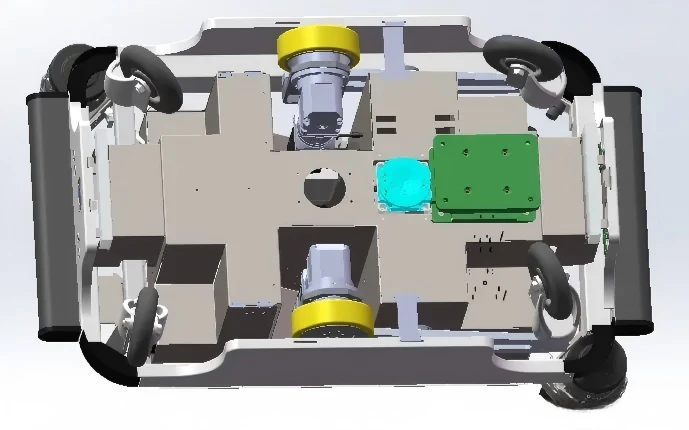
Differential Drive Wheel System Structure
A differential drive AGV typically consists of two powered drive wheels and multiple caster wheels for support.
Vehicle motion is controlled by adjusting the speed difference between left and right drive wheels.
Equal speed results in straight movement
Different speed results in curved movement
Opposite direction results in in place rotation
This archiPLTture is widely used in industrial AGVs AMRs tugger systems and automated material handling platforms due to its simple structure and high reliability.

Motion Resistance Model
The total driving resistance consists of three main components
Rolling resistance
F_roll = (m - m_drive) * g * mu
m is total vehicle mass
m_drive is load supported by drive wheels
mu is rolling resistance coefficient depending on floor conditions
Acceleration force
F_acc = m * a
a is acceleration of the vehicle
This is a key factor in dynamic performance especially for high speed AMR applications
Grade resistance
F_grade = m * g * sin(theta)
theta is slope angle
For flat indoor applications this value is zero
Total driving force
F_total = F_roll + F_acc + F_grade
This value is used as the basis for all torque calculations
Straight line operation torque
In straight motion both drive wheels share the load equally
Force per wheel
F_straight = F_total / 2
Wheel torque
T_straight = F_straight * (D / 2)
D is drive wheel diameter
This condition is used to verify continuous operation capability and thermal stability of the motor system
In place rotation critical condition
In place rotation is the most demanding working condition for differential drive wheel AGVs
During this motion one drive wheel rotates forward while the other rotates in reverse
Caster wheels generate maximum steering resistance which significantly increases torque demand
Engineering approximation of rotational resistance
F_spin = (2 * F_roll * sqrt(W^2 + L^2)) / W
W is drive wheel spacing
L is vehicle body length
Required torque
T_spin = F_spin * (D / 2)
In most industrial AGV applications in place rotation torque is typically two to five times higher than straight line torque
This condition is the primary reference for motor selection in most projects
Curved motion condition
In real operating environments AGVs spend most of their time in curved motion
Wheel speeds differ and caster wheels introduce steering resistance
Torque relationship
T_straight < T_curve < T_spin
Curved motion is mainly used for motion stability validation and control system tuning
Load inertia and gear ratio matching
Inertia matching plays a critical role in motion performance and control stability
Equivalent load inertia at wheel side
J_load = (m / 2) * (D / 2) * (D / 2)
Motor side inertia after gearbox reduction
J_motor = J_load / (i * i)
i is gear ratio
Recommended inertia ratio guidelines
Servo system below 5 to 1
Stepper system below 10 to 1
Proper inertia matching improves acceleration response positioning accuracy and system stability
Engineering considerations for drive wheel selection
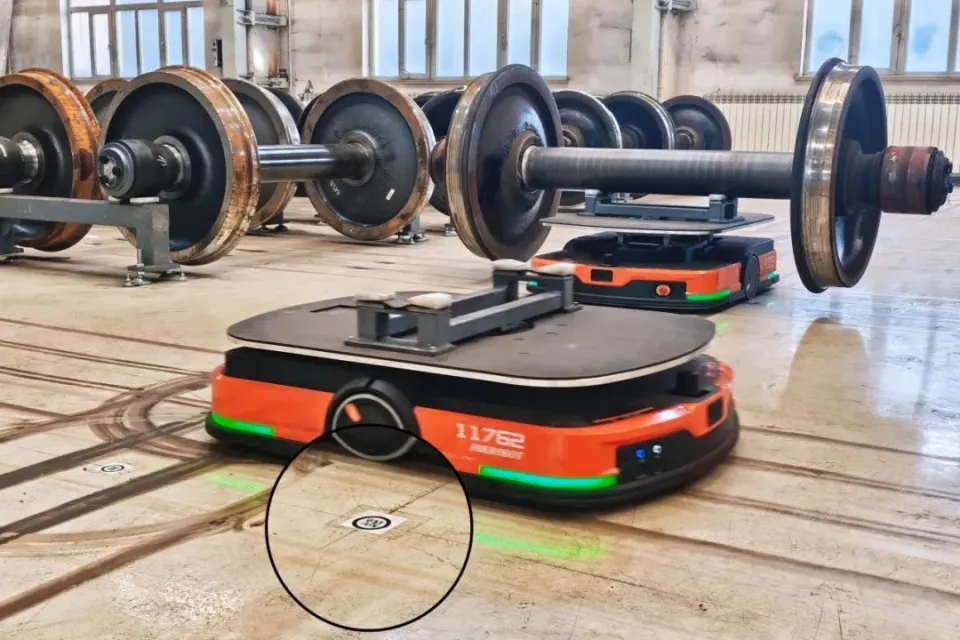
In real AGV system design torque calculation alone is not sufficient
The following factors must also be considered
traction performance between wheel and floor
gearbox lifetime and thermal behavior
continuous duty operation capability
floor condition variation
load distribution and center of gravity shift
Ignoring these factors may lead to wheel slip overheating or unstable motion control
PLT series differential drive wheel solutions
Plutools and Yikong Intelligent Equipment provide the PLT series differential drive wheel systems as integrated solutions for AGV manufacturers
The PLT series integrates low voltage servo motors precision gearboxes and industrial grade drive wheels into a compact modular system
Typical models include PLT85 PLT240 and PLT550 covering a wide range of load capacities for different AGV applications
These products are widely used in
warehouse AGVs
autonomous mobile robots
tugger AGVs
industrial mobile platforms
heavy duty logistics systems
By using integrated drive wheel solutions manufacturers can significantly reduce development complexity improve system reliability and shorten project development cycles

Conclusion
Differential drive wheel AGV motor sizing must be based on a complete multi condition engineering model rather than simplified weight estimation
Straight motion defines continuous torque requirement
Curved motion validates system stability
In place rotation defines maximum torque requirement
By combining torque calculation inertia matching and practical engineering constraints AGV developers can achieve stable efficient and reliable system performance in industrial environments


