

I. Origins and Integration of the Technology
The evolution of AGV technology is a microcosm of the development of industrial automation. In 1913, Ford introduced track-guided vehicles that, like mechanical rails on the ground, transported parts along fixed routes at a slow speed of 0.3 m/s-a rigid mode of transportation that lasted for nearly half a century. It wasn't until 1953 that electromagnetic guidance technology emerged. By embedding cables carrying a 10 kHz frequency beneath the workshop floor to create an electromagnetic field, AGVs achieved a positioning accuracy of ±15 mm. However, any change in the route still required rewiring, making modifications extremely costly.
The true revolution occurred in the early 21st century. With the development of QR codes by Japan's Denso company, which became an international standard in 2004, the storage capacity of QR codes broke through the 7 KB barrier. A single code could hold complete logistics information such as workshop coordinates and equipment parameters. In 2012, Germany's KUKA was the first to integrate industrial-grade QR code readers with AGVs. In a pilot at BMW's Leipzig factory, the path adjustment that traditionally took three days with magnetic guidance was completed in just two hours. This breakthrough technology directly promoted the transformation of AGVs from "fixed track trains" into "intelligent transport robots."

Since the 2010s, as QR code recognition technology matured and AGV navigation requirements advanced, QR code navigation gradually replaced traditional electromagnetic or magnetic tape guidance systems. In China, AGV QR code navigation technology rapidly developed after 2010, finding widespread application in automotive manufacturing and warehousing logistics. This advancement has improved AGV positioning accuracy and flexibility, while also expanding its application scope.
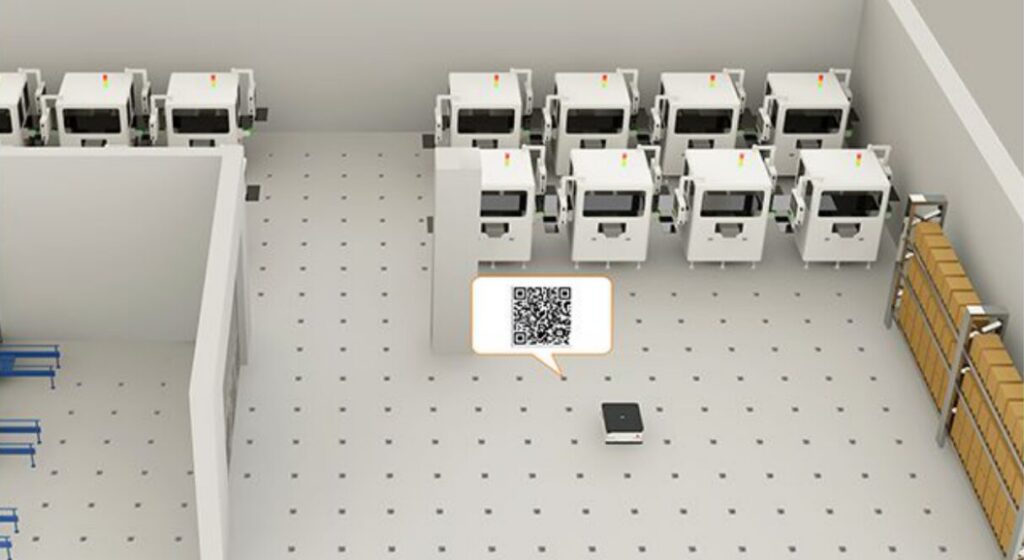
II. Application Principles
Navigation and Positioning Mechanism
AGVs are equipped with code readers that scan ground QR codes to obtain position encoding, coordinate offsets, and heading angle data. The scheduling system generates a navigation command sequence based on the QR code coordinate information, and the AGV moves from "point to point," with its heading corrected by an IMU sensor. By combining QR code positioning, IMU data, and encoder information, high-precision positioning is achieved.
Closed-Loop Control System
The AGV controller adjusts wheel speeds in real time based on the offset feedback from the QR codes to ensure travel along the preset path. By integrating encoder mileage data, IMU heading angles, and QR code positioning information, a high-precision closed-loop control system is formed, achieving positioning accuracy of up to ±1 mm. Through closed-loop control, the AGV can operate stably in dynamic environments, adapting to complex road conditions and task requirements.
System Architecture and Functional Modules
Perception Layer: Comprising code readers, LiDAR, and obstacle avoidance sensors working together to achieve environmental perception and safety protection.
Decision Layer: Communicates between the upper-level control system and the AGV's standalone control module to complete task allocation, path optimization, and exception handling.
Execution Layer: Relies on drive motors and material handling mechanisms (such as push-pull or roller systems) to perform transport tasks and interfaces with the Warehouse Management System (WMS).
III. Technical Advantages and Typical Scenarios
Technical Advantages
Flexible and Adjustable Paths: QR code navigation paths can be quickly modified according to production needs.
High Positioning Accuracy: Compared to traditional guidance methods, the positioning accuracy can reach up to ±1 mm, meeting the demands of precision manufacturing.
Ease of Maintenance: QR code labels are simple to maintain, reducing guide rail wear and maintenance costs.
Typical Scenarios
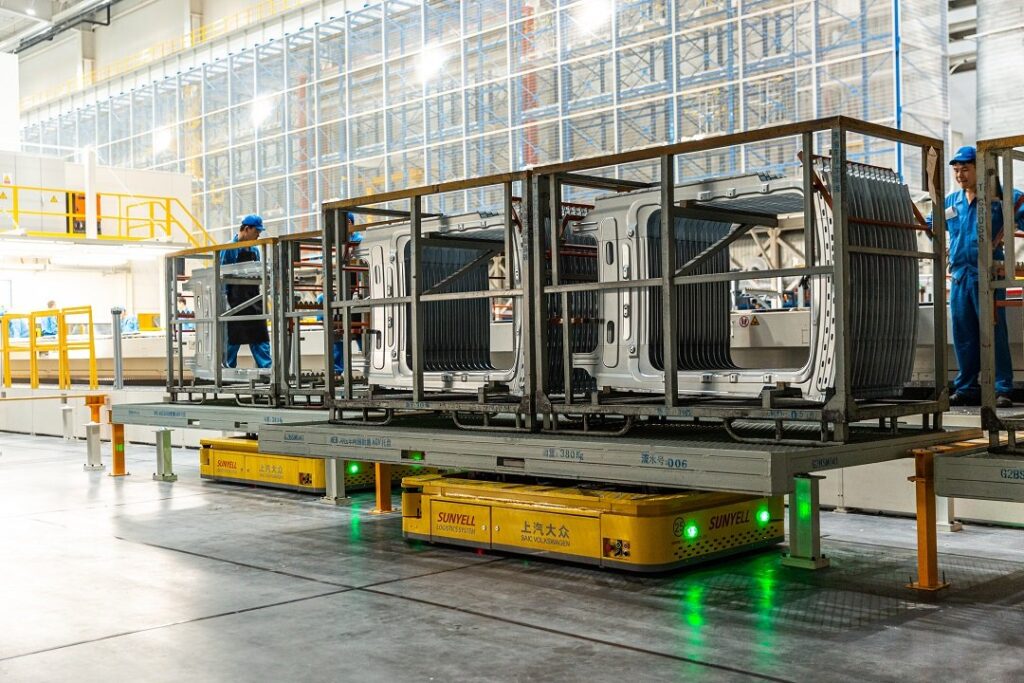
Automotive Manufacturing: At FAW-Volkswagen's Foshan factory welding workshop, 3,200 ceramic QR code labels with a compressive strength of 5 tons/m² are installed. The flexible conveying system composed of AGVs achieves a positioning accuracy of ±0.2 mm for car body assemblies, reducing the changeover time in mixed production from 4 hours to 18 minutes. Dual-check QR codes combined with visual guidance at each key workstation have reduced assembly errors to one in a million.
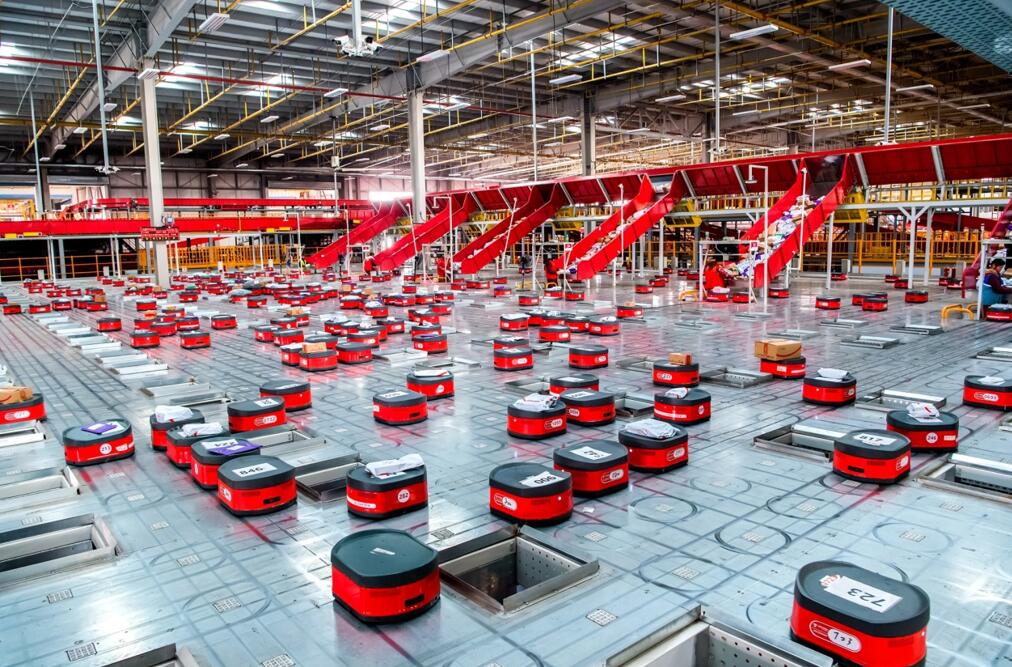
Intelligent Warehousing: In JD.com's Shanghai Asia No.1 Warehouse, a nine-grid QR code layout is employed. Each shelf is embedded with three check codes at the bottom, and when combined with dual-frequency RFID identification technology, warehouse density is increased by 40%, with picking accuracy reaching 99.99%.
Pharmaceutical Cold Chain: In specialized applications for pharmaceutical cold chain warehouses, QR code labels are coated with a low-temperature resistant layer that can maintain functionality for 10 years at -25°C, ensuring reliable AGV navigation in frozen environments.
IV. Detailed Steps of the Application Principle
Initialization of the Navigation System and QR Code Layout
Ground Preparation: The floor is treated with an epoxy resin self-leveling process, with a flatness requirement of ≤3 mm per 2 m.
QR Code Label Installation: Labels are embedded flush with the ground and covered with a 5 mm polycarbonate wear-resistant layer. Each label contains unique position encoding, offset, and heading angle information in a standardized format. Labels are installed along the AGV's route at intervals of 1 to 3 meters to form a navigation network, covering key areas. Labels should avoid high-wear areas and be maintained regularly.
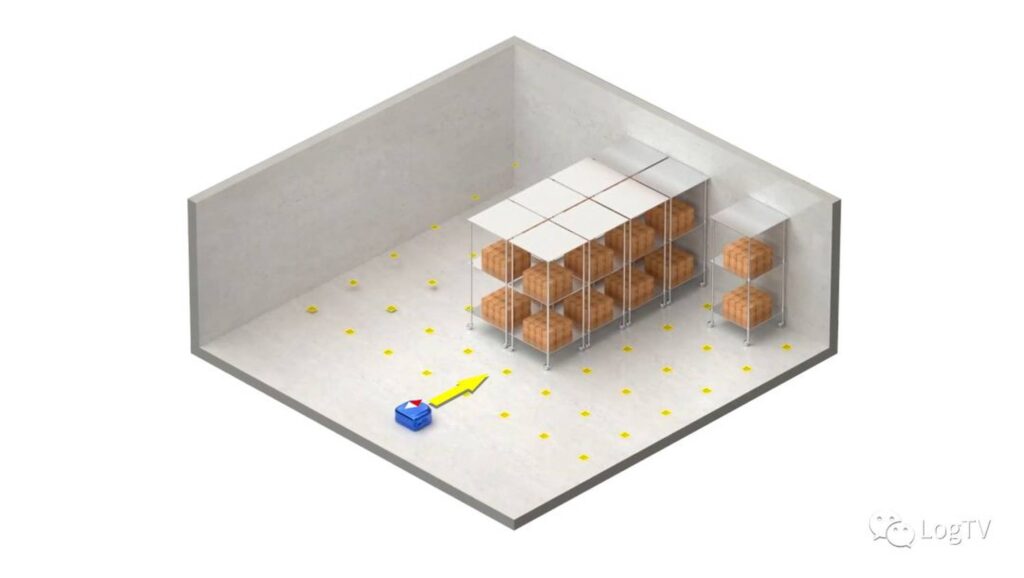
QR Code Recognition and Data Acquisition
Image Capture: AGVs are equipped with high-resolution cameras or laser scanners to capture QR code images. Image processing algorithms extract the label information.
Data Transmission: Sensors transmit position coordinates, offset, and heading angle data in real time to the controller. The sensor installation height and angle are optimized to ensure effective recognition.
Data Processing and Positioning Calculation
Global Matching: The controller matches the QR code's position encoding with the preset global coordinate map to determine the AGV's absolute position.
Error Correction: Based on the offset and heading angle feedback from the QR code, deviations from the preset path are calculated and correction commands generated. Encoder mileage data and IMU heading angles are combined to correct cumulative errors and improve positioning accuracy.
Path Planning and Dynamic Adjustment
Command Generation: The scheduling system generates a navigation command sequence based on task requirements and sends it to the AGV controller.
Real-Time Adjustment: As the AGV travels, it continuously reads QR code data. If an offset greater than 5 mm is detected, the PID control algorithm adjusts the drive wheel speed to bring it back to the preset path. In areas between QR codes, the AGV relies on IMU and encoder data to estimate its position until the next label is encountered for recalibration.
Multi-Sensor Fusion and Closed-Loop Control
Obstacle Detection: LiDAR and ultrasonic sensors continuously monitor for obstacles, triggering emergency avoidance or path replanning if necessary.
Integrated Control: The controller integrates QR code positioning, sensor feedback, and motion control commands to form a closed-loop system, achieving positioning accuracy at the ±1 mm level. Obstacle avoidance signals are fused with navigation data to ensure the AGV operates safely in dynamic environments.
V. Summary of Key Processes
Initialization: Lay QR code labels containing position and orientation information.
Recognition: Capture and parse label data using visual sensors.
Positioning: Match global coordinates and correct errors to complete positioning.
Path Execution: Follow the command sequence and dynamically adjust the trajectory to maintain the intended path.

For the past 22 years, Plutools has focused on the research, production, and sales of core components for mobile robots (AGV/AMR), including drive wheels, motor controllers, differential wheels, reduction motors, and servo motors. With outstanding technology, reliable quality, and competitive pricing, Plutools has grown into one of China's largest integrated mobile robot suppliers. We provide solutions and high-quality products to clients in various industries both domestically and internationally.


